
Never learned
You avoided pools your whole life, or had a bad experience as a kid. We start with standing in water and build from there — no pressure, no audience.
Home / About
Nearly four years instructing across four swim programs, teaching swimmers of every age. I work with adults who were never taught properly the first time — and adults who can already swim, but know something is off.
Background
Most adults who cannot swim were not failed by the water. They were failed by a class of twelve, a whistle, and an instructor who did not have time to notice them.
I have taught across four swim programs — Nereids Aquatic Centre, Sydney Olympic Park, Waves Aquatic Centre and Future Swim — with students of every age, from toddlers to retirees. The pattern was the same everywhere: the people who needed the most attention were getting the least of it.
So I started Vital Swim Academy. One-on-one, in a pool where nobody is watching, adults learn remarkably fast — provided nobody rushes them.
How I teach
I do not move a swimmer forward until the current stage is genuinely comfortable. It is tempting to rush — it feels like progress. It is not. Skipping ahead is the single most reliable way to plateau, because every later skill is built on the one underneath it.
Small, compound efforts lead to long-term change. Never rush the learning process.
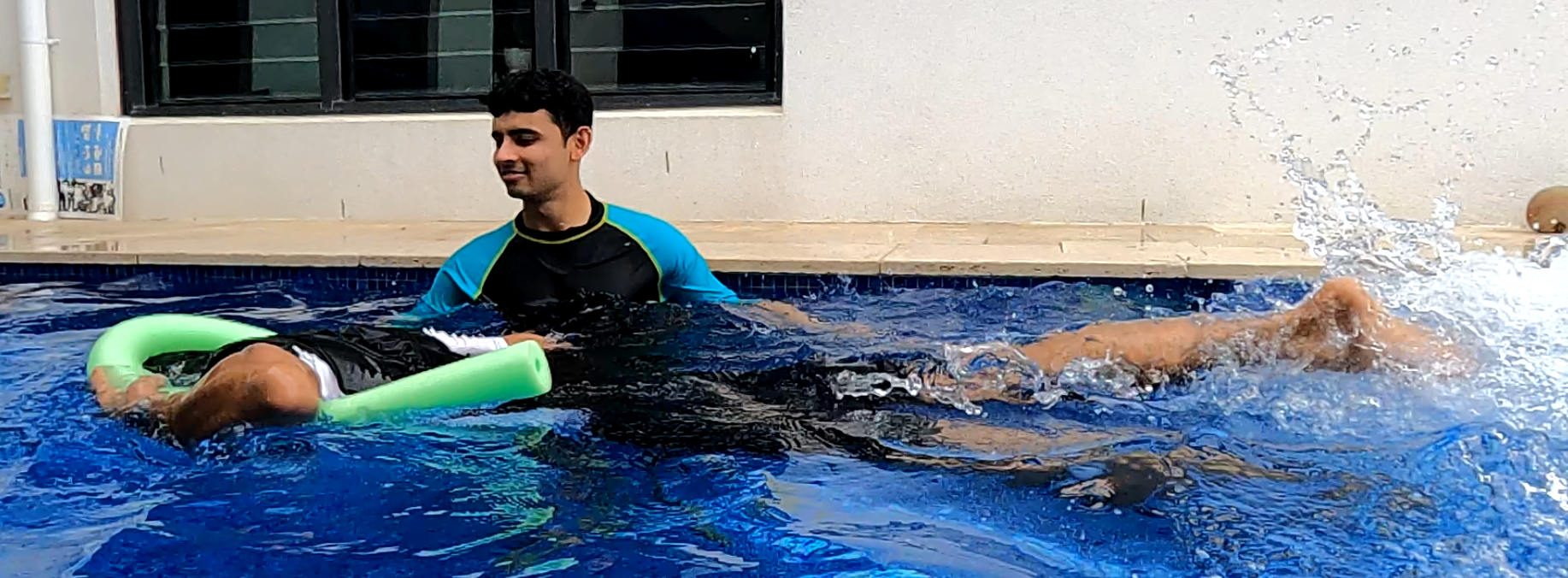
You cannot correct a stroke while someone is tense. Before anything else, we get you comfortable — standing, walking, breathing, floating — so your attention is free to go to your actual swimming. A body in mild panic cannot learn.
This is also why I never force facial immersion. Pushing someone under works against their natural instinct, delays the process, and teaches the wrong association with water. We build it in stages instead, and it holds.
Most swimmers who "run out of breath" are not unfit — they are over-breathing. Holding your breath, then gasping, flicks the body into panic. Learning a steady exhale into the water raises your CO₂ tolerance, keeps you relaxed, and lets you swim further with less effort.
I teach a simple three-second rhythm that becomes automatic. Once you stop thinking about breathing, you have the mental bandwidth left over for everything else.
Telling someone to "engage the posterior chain" helps almost nobody. Telling them to imagine their leg as a battle rope — shaken from the hip, travelling all the way to the toes — changes the kick immediately.
Shared images stick. Technical breakdowns evaporate the moment your face goes back in the water. I coach with cues you will still remember next week.
Who I work with
You avoided pools your whole life, or had a bad experience as a kid. We start with standing in water and build from there — no pressure, no audience.
You get across the pool but it is exhausting and it does not look right. We rebuild the stroke properly rather than patching it.
A triathlon, an ocean swim, a fitness goal. We work on efficiency, breathing under load, and getting more distance out of less energy.
Credentials
Every credential below is current and independently verifiable. Two are downloadable here; the third you can check directly with the regulator.
Verify this number against my name with the Office of the Children's Guardian.
The first conversation costs nothing. Tell me where you are with swimming and I will tell you honestly whether I can help.